Rust Video Game: Complete Survival, Building and Raiding Guide
Rust Video Game: Complete Survival, Building and Raiding Guide
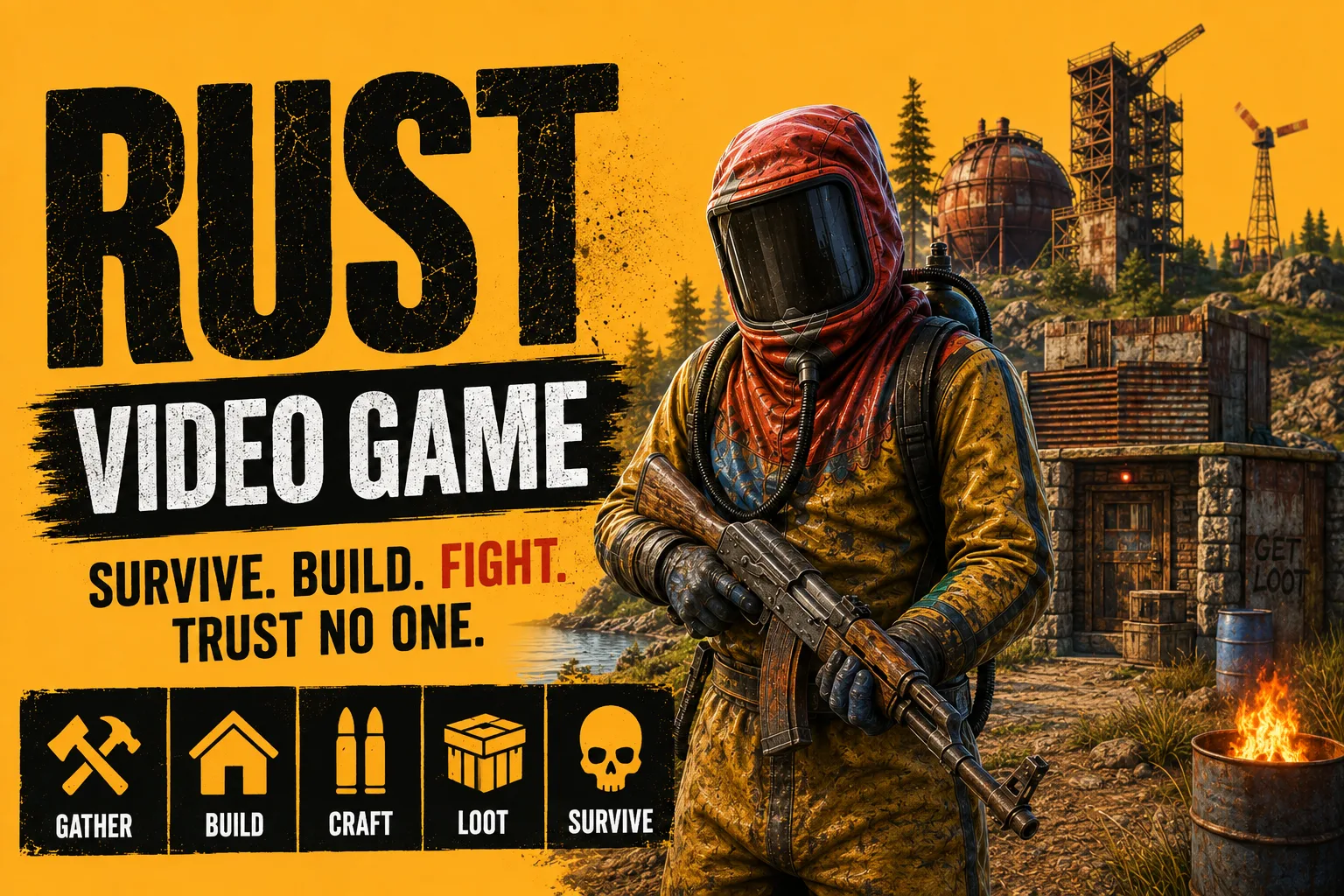
The Rust video game turns a simple survival objective into one of the most unpredictable multiplayer experiences on Steam. You begin with almost nothing, gather resources from the environment, craft basic equipment, build a shelter, and gradually work toward stronger weapons, safer bases, and access to more valuable areas of the map.
The difficult part is that thousands of carefully collected resources can disappear because of one bad decision. Another player can ambush you on the way home, a rival group can raid your base, or a trusted teammate can create problems from inside. Rust is not only about surviving the island. It is about surviving the people sharing it with you.
This guide explains how Rust works, what beginners should prioritize, how progression develops during a wipe, and why building, exploration, PvP, and player interaction are all connected.
Quick Answer: What Is the Rust Video Game?
Rust is an online multiplayer survival game developed by Facepunch Studios. Players gather resources, craft equipment, construct bases, explore monuments, research technology, fight other survivors, and protect their accumulated loot.
There is no traditional campaign directing every player toward the same ending. Your objectives are created by the server, your available resources, the people around you, and the risks you decide to take.
A typical Rust session may involve:
- Gathering wood, stone, metal, cloth, and food
- Crafting tools, weapons, armor, and medical supplies
- Building and upgrading a secure base
- Searching monuments for components and valuable loot
- Unlocking new items through progression systems
- Trading or cooperating with other survivors
- Fighting players for territory and resources
- Raiding enemy bases or defending your own
How Does Rust Start?
A fresh start in Rust is intentionally harsh. You appear with minimal equipment and no protected inventory. The nearby coastline often contains other recently spawned players who are searching for exactly the same resources.
Your first priority should be establishing a reliable respawn point and a small place to store loot. Trying to find high-level weapons immediately usually creates unnecessary risk.
A Good Early-Game Order
- Move away from crowded spawn areas.
- Collect wood and stone.
- Craft basic gathering tools.
- Gather cloth and place a sleeping bag.
- Find enough food to stabilize your health.
- Choose a practical base location.
- Build a compact starter base.
- Add secure doors, storage, and a Tool Cupboard.
- Begin gathering resources for upgrades and better equipment.
The goal is not to become powerful during the first few minutes. It is to create enough stability that one death does not reset all of your progress.
Gathering Resources in Rust
Resource management controls almost every stage of progression. Building too much wastes construction materials, while carrying too much can turn one death into a major setback.
Wood
Wood supports early construction, basic crafting, furnaces, tools, and many deployable items. New players commonly underestimate how quickly it disappears during the first base setup.
Stone
Stone is especially valuable when upgrading a vulnerable starter base. Moving beyond weak building grades early can discourage opportunistic attacks and increase the effort required to break inside.
Metal
Metal becomes increasingly important as progression continues. It is used throughout crafting, stronger building sections, doors, weapons, ammunition, and equipment.
High Quality Metal
High Quality Metal should usually be treated as a premium resource. Avoid wasting it on unnecessary upgrades when important weapons, components, or defensive improvements still need to be crafted.
Scrap and Components
Roads, monuments, containers, and industrial locations provide components and Scrap that support technological progression. Efficient players combine resource farming with component runs instead of focusing on only one material type.
How Base Building Works
A base is your storage location, crafting area, respawn point, and primary defense against other players. Good base design does not necessarily mean building the largest structure possible.
A useful starter base should contain:
- A Tool Cupboard in a protected position
- At least one sleeping bag
- An airlock at the main entrance
- Organized storage
- A furnace
- Space for essential crafting stations
- A clear upgrade path for future expansion
Why an Airlock Matters
An airlock uses multiple doors to prevent someone outside from gaining immediate access to the entire base when you open the entrance. It is one of the simplest improvements a beginner can make.
Why the Tool Cupboard Matters
The Tool Cupboard helps control building authorization and upkeep. Keep it protected and supplied with the resources required by your structure.
Expanding a base increases the amount of material you must maintain. Build according to what you can realistically farm instead of creating a huge compound that becomes difficult to support.
Choosing a Good Rust Base Location
Location can determine how difficult an entire wipe becomes. A base next to a valuable monument provides convenient access to loot, but it also places you near players who are actively looking for fights.
Before placing foundations, consider:
- Nearby stone, metal, wood, and food
- Distance from roads and monuments
- Existing compounds in the area
- Visibility from nearby hills
- Access to safe farming routes
- Potential expansion space
- Traffic between popular areas
Remote bases can be quieter, but every loot run may take longer. Central bases offer faster progression while exposing you to more enemies. The best choice depends on whether you prefer safety, PvP, farming, or rapid monument access.
What Are Monuments in Rust?
Monuments are recognizable locations that provide loot, components, resources, and opportunities for progression. They also attract other players, making them some of the most dangerous areas on active servers.
Industrial structures, abandoned facilities, roadside locations, underground areas, and other points of interest can offer different levels of risk and reward.
Before approaching a monument:
- Bring appropriate clothing and medical supplies.
- Listen for gunfire before entering.
- Avoid running directly through open areas.
- Check likely ambush positions.
- Know how you will leave before collecting loot.
- Return valuable items to your base instead of becoming unnecessarily greedy.
Getting loot is only half of a successful monument run. Bringing that loot safely home is what actually advances your wipe.
How Progression Works in Rust
Progression combines crafting knowledge, workbenches, researched items, collected components, better equipment, and increasingly secure infrastructure.
A useful progression path is:
- Establish a starter base.
- Secure basic tools and weapons.
- Collect Scrap and components.
- Improve your crafting options.
- Unlock dependable weapons and ammunition.
- Create replacement equipment sets.
- Upgrade important base sections.
- Expand storage and production.
- Prepare for larger monument runs and raids.
Do not judge progression only by the weapon in your hands. A player with organized storage, several replacement kits, enough upkeep, and a secure base may be in a stronger position than someone carrying an expensive weapon with nowhere safe to return.
PvP and Player Encounters
Player-versus-player combat is one of the defining parts of Rust, but not every encounter needs to become a fight.
You may meet farmers, traders, roleplayers, new players, organized clans, roaming PvP groups, or someone pretending to be friendly while waiting for an opportunity to attack.
A few habits improve survival:
- Use terrain and buildings as cover.
- Avoid standing still in exposed areas.
- Listen for footsteps before entering structures.
- Carry enough healing for the trip.
- Do not reveal your base location unnecessarily.
- Avoid chasing enemies into unfamiliar terrain.
- Leave when the potential reward no longer justifies the risk.
Good positioning can defeat better equipment. Rust rewards awareness, patience, timing, and knowledge of the surrounding terrain.
Solo Rust vs. Playing with a Team
Playing Solo
Solo Rust offers complete control over your resources and decisions, but every task must be handled alone. Farming, building, crafting, monument runs, defense, and organization all compete for your time.
Small bases, efficient storage, short farming routes, and selective fights are especially valuable for solo players.
Playing with a Team
Groups can divide responsibilities. One player can farm while another builds, organizes storage, crafts equipment, or watches for enemies.
Team play also introduces another risk: access. Be careful about sharing door codes, Tool Cupboard authorization, and valuable storage with players you do not completely trust.
How Raiding Works
Raiding allows players to break through another base's defenses and access the resources stored inside. It is one of the most expensive and potentially profitable activities in Rust.
A successful raid requires more than explosives. Information matters.
Before attacking a base, consider:
- The likely location of the Tool Cupboard
- The number and type of doors
- Possible loot rooms
- Nearby defenders and allies
- Alternative breach paths
- Whether the potential loot justifies the cost
- How you will transport items back home
Defenders should think in the opposite direction. Spread important resources intelligently, strengthen the core, create replacement kits, and avoid base designs where every valuable item is behind one obvious path.
What Is a Rust Wipe?
A wipe resets server progress and gives players another chance to compete from a fresh starting point. Depending on the server, a wipe can reset the map, player structures, inventories, and potentially other forms of progression.
Server administrators may use different schedules, so check the description or community information before joining.
Early wipe is usually highly competitive. Players race for good base locations, resources, Scrap, weapons, and control of important areas. Later in the wipe, established groups often have stronger compounds and larger equipment reserves.
Understanding where a server is in its wipe cycle can help you decide whether to join immediately or choose another server.
Choosing the Right Rust Server
Server selection changes the experience dramatically. New players sometimes assume every server plays the same way, but population, rules, team limits, gathering rates, and modifications can create very different environments.
Official Servers
Official servers provide a competitive multiplayer experience and can contain highly experienced players and organized groups.
Community Servers
Community servers may introduce team limits, custom rules, active moderation, or environments designed specifically for solo players and smaller teams.
Modded Servers
Modded servers can increase resource rates, accelerate progression, introduce custom game systems, or significantly change the standard Rust experience.
Beginners often learn faster on a moderately populated server where they have enough player interaction to understand PvP without being attacked every few minutes.
Common Rust Beginner Mistakes
Building Too Much Too Early
Oversized starter bases consume resources, increase upkeep, and attract attention. Build a strong core before expanding.
Farming Until Your Inventory Is Full
Regularly deposit valuable materials. Do not risk an hour of gathering just to avoid spending two minutes returning home.
Opening Doors Without Checking Outside
Listen before leaving your base. Door campers may wait nearby for an easy opportunity to gain access.
Taking Every Fight
Some battles have almost no potential reward. Surviving with your current inventory can be more valuable than chasing a stranger across the map.
Keeping Everything in One Storage Room
Centralized loot is convenient for you and equally convenient for raiders. Consider separating critical materials and emergency equipment.
Trusting Too Quickly
Social interaction creates some of Rust's best moments, but access to your base should be earned slowly.
Why Rust Remains So Unpredictable
The systems in Rust are important, but players create the real unpredictability. Two servers running the same map can produce completely different experiences.
On one server, your neighbors may establish a trading community. On another, the same location could become the center of a territorial war. A stranger may return equipment after defeating you, while another player may spend an entire evening waiting outside your door.
This uncertainty gives every wipe its own identity. You are not simply learning crafting recipes or building patterns. You are learning how to react when other people interfere with your plans.
For additional Rust guides, game-focused articles, survival resources, and community content, visit Rustnecro.com.
Frequently Asked Questions
What is the Rust video game about?
Rust is a multiplayer survival game focused on gathering resources, crafting, building bases, exploration, PvP, cooperation, and raiding. Players create their own goals rather than following a traditional campaign.
Is Rust difficult for beginners?
Rust has a challenging learning curve because players must understand survival, building, crafting, combat, monuments, progression, and server behavior at the same time. Beginner-friendly community servers can make learning easier.
Can you play Rust solo?
Yes. Solo Rust is completely possible, although gathering, base defense, and fighting organized groups can be more demanding. Solo-only and limited-team servers are also available.
Does Rust have PvP?
Yes. PvP is a major part of the standard multiplayer experience. Players can fight over resources, monuments, territory, loot, and bases.
Can you build your own base in Rust?
Yes. Base building is a core mechanic. Players construct foundations, walls, floors, roofs, doors, storage areas, defensive sections, and increasingly complex compounds.
What happens during a Rust wipe?
A wipe resets server progress according to that server's schedule and configuration. It gives players another opportunity to begin again, claim new territory, and compete from an earlier progression stage.
Is Rust only about raiding?
No. Players can focus on farming, building, trading, exploration, PvP, electricity, vehicles, roleplay, community interaction, or many other activities. Raiding is important, but it is only one part of the sandbox.
Is Rust worth learning as a new player?
Rust rewards players who enjoy competitive survival games, sandbox freedom, base building, unpredictable multiplayer interaction, and progression that carries real risk. The first sessions can be difficult, but experience makes rebuilding and progressing much faster.
Final Thoughts
The Rust video game works because progress never feels completely safe. You can transform a small shelter into a fortified compound, collect valuable equipment, control nearby resources, and still lose everything when another group finds the right weakness.
Beginners should focus on fundamentals: build small, secure the Tool Cupboard, deposit resources frequently, learn nearby monuments, prepare replacement equipment, and choose fights carefully.
Death, raids, and wipes are not exceptions to the Rust experience. They are part of it. The players who improve fastest are usually the ones who learn something from every loss and return to the beach with a better plan.